
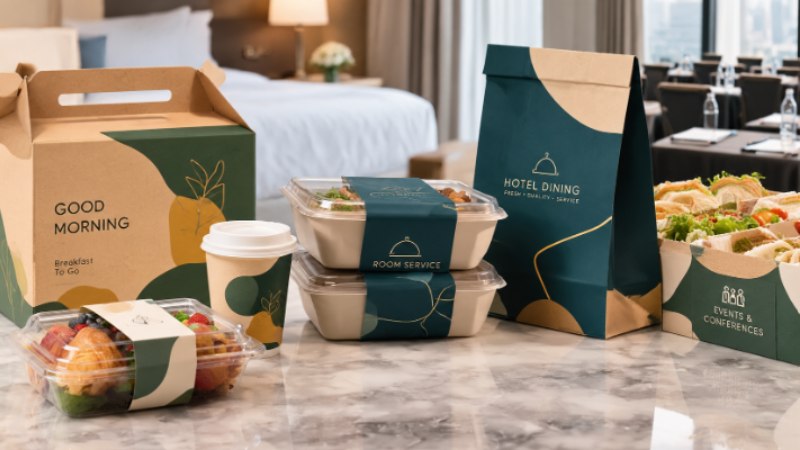
Hotel food service does not end when a plate leaves the kitchen.
A breakfast box may need to travel to a guest’s room. A pastry may sit on a grab-and-go counter before being taken to work. A conference lunch might be packed for hundreds of people and moved across a hotel before anyone opens it.
Each situation creates a slightly different packaging problem.
The container needs to protect the food, but it also has to fit the way the hotel actually operates. That is why choosing packaging for hotel dining is less about finding one “best” box and more about matching the format to the food and the occasion.
Hotel breakfast takeaway needs to be easy to carry
Breakfast is one of the simplest examples.
A hotel may offer guests croissants, muffins, fruit, yogurt, sandwiches, pastries, juice and coffee as part of a grab-and-go breakfast. Those foods do not behave in the same way during storage or transport.
A pastry needs enough room to avoid being crushed. Fruit and yogurt need secure lids. A breakfast sandwich may need stronger structure, such as a custom sandwich paper box. If it is going to be carried away rather than eaten at the breakfast table.
The packaging also needs to work quickly.
During a busy morning, staff should not have to spend a long time assembling each order. A straightforward format that can be filled, closed and handed to a guest without unnecessary steps can make the breakfast operation smoother.
Room service has a different set of expectations
Room service is more personal.
When a meal reaches a guest’s door, it is part of the hotel experience rather than simply another takeaway order. Packaging therefore needs to combine practical food protection with clean presentation.
Stability is particularly important. Containers may travel on carts, trays or through lifts before reaching the room. A lid that fits poorly or a container that allows food to shift can create a mess before the guest even opens it.
Hot food also needs careful handling. Steam can build up inside a sealed container, which may affect foods that are supposed to remain crisp. A package that works well for soup may not be suitable for fried food or toasted sandwiches.
The food should determine the container.
Pastries and bakery items need protection without being overpacked
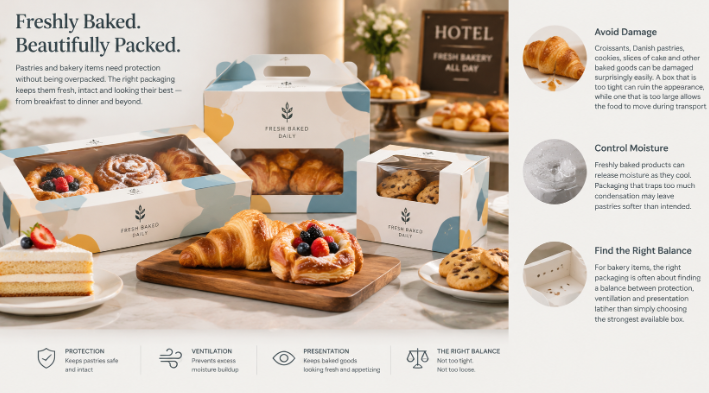
Hotels often serve bakery products throughout the day, not only at breakfast.
Croissants, Danish pastries, cookies, slices of cake and other baked goods can be damaged surprisingly easily. A box that is too tight can ruin the appearance, while one that is too large allows the food to move during transport.
Moisture is another concern.
Freshly baked products can release moisture as they cool. Packaging that traps too much condensation may leave pastries softer than intended.
For bakery items, the right packaging is often about finding a balance between protection, ventilation and presentation rather than simply choosing the strongest available box.
Conference catering creates a logistics problem
Events are where packaging decisions become much more complicated.
A hotel hosting a conference may need to prepare hundreds of breakfast packs, boxed lunches, snacks or desserts within a narrow time window. The packaging needs to be consistent enough for staff to work quickly and stable enough to survive movement from the kitchen to the event space.
This is where stackability matters.
Containers that sit securely on top of each other are easier to transport and store. A stable shape also reduces the chance that food will shift inside the package.
At the same time, event catering often includes several food types in one order. Sandwiches, fruit, desserts, sauces and salads may need different levels of protection.
Trying to force every item into the same container can create more problems than it solves.
Hotel restaurant takeaway needs to survive the journey
A hotel restaurant may also serve guests who prefer to take their food away.
That changes the restaurant’s packaging requirements.
Food that is served a few metres from the kitchen has a relatively short journey. Takeaway food may spend much longer moving through a lobby, waiting in a vehicle or travelling to another destination.
During that time, heat, steam, grease and movement start to affect the meal.
A burger can lose its texture inside a poorly ventilated container. Sauces can leak from an unstable lid. A salad may become watery if wet ingredients are packed incorrectly.
The package needs to be selected according to the journey, not simply the menu description.
Different foods call for different packaging
A useful hotel packaging system starts by grouping foods according to their practical requirements.
Hot soups and saucy dishes need strong leak resistance and secure closures.
Fried foods need grease resistance and enough ventilation to manage steam.
Sandwiches and burgers need a close fit that prevents excessive movement while avoiding unnecessary pressure on the food.
Pastries and cakes need protection from crushing and, depending on the product, some ability to release moisture.
Cold foods such as fruit, yogurt and salads may need clear lids, stable bases and better moisture control.
There is no reason every item in the hotel kitchen should use the same packaging format.
The material should follow the food
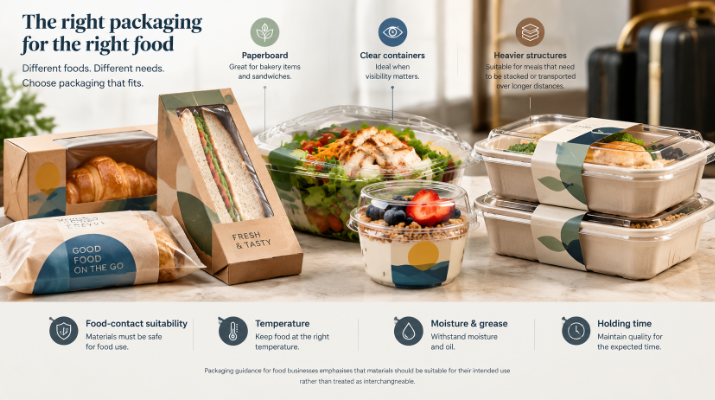
Paperboard, fibre-based containers, plastic formats and other materials can all have a place in hotel food service.
The important question is what the package needs to do.
A natural-looking paper box may work well for bakery items or sandwiches, while a clear container may be more useful when visibility matters. A heavier structure may be justified for meals that need to be stacked or transported over a longer distance.
Food-contact suitability also needs to be considered alongside temperature, moisture, grease and the expected holding time. Packaging guidance for food businesses emphasises that materials should be suitable for their intended use rather than treated as interchangeable.
Test packaging the way guests will use it
One of the easiest mistakes is judging packaging while it is empty.
Hotel teams should test it with actual food.
Pack a real breakfast takeaway and carry it through the same route a guest would take. Prepare a room service meal and check the packaging after the expected delivery time. For event catering, stack the containers and move them as staff would on the day.
Look for practical issues:
Does the lid stay closed?
Does the food move around?
Does steam build up?
Does grease weaken the material?
Can staff pack it quickly?
Does the package still look presentable when the guest opens it?
A short real-world test can reveal problems that are invisible on a supplier specification sheet.
Better packaging can simplify hotel operations
The most useful packaging is not necessarily the most expensive one.
For a hotel, the better choice is often the package that protects the food, works with existing service routines and does not create unnecessary complexity.
Standardising a few formats can simplify storage and staff training, while still allowing different packaging for foods with genuinely different requirements.
That balance becomes particularly valuable when breakfast service, room service, events and restaurant takeaway all share the same kitchen or purchasing system.
Good hotel packaging should make food easier to serve, easier to transport and easier for the guest to enjoy.
When the packaging is matched to the food and the journey, it quietly solves problems before the guest ever notices them.